
Standing seam metal roofing in Colorado
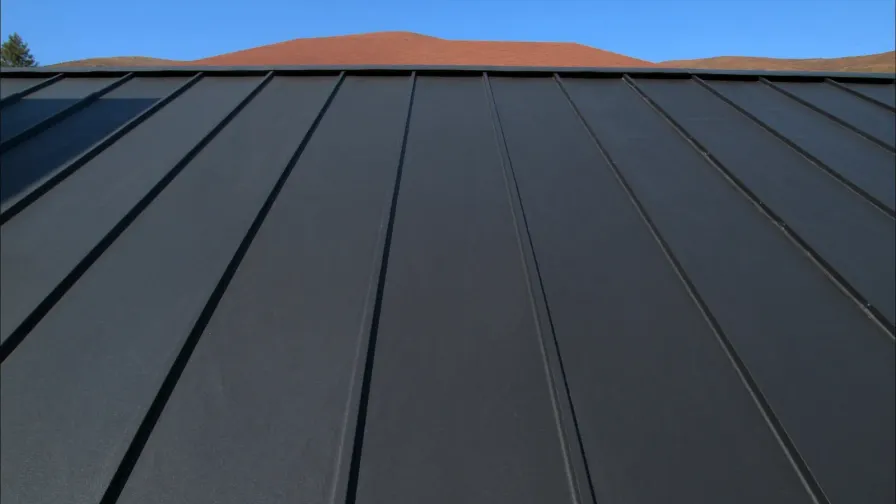
Standing seam is what most Front Range homeowners mean when they say metal roof. Panels run vertically from ridge to eave and lock together at raised seams, with the fasteners concealed inside the seam rather than driven through the panel face. It is the top of the metal price range and the longest-lived option.
Why the concealed fastener matters here
On exposed-fastener metal, every screw through the panel face is sealed by a washer, and those washers are the part that ages. Colorado gives them a hard life: intense UV at altitude, wide daily temperature swings that expand and contract the panel around every fastener, and hail that hits the fastener head directly. Standing seam removes that failure mode from the weather surface entirely, and the seam clips let the panel move as it heats and cools.
Class 4 and your premium
Most standing seam systems carry a UL 2218 Class 4 impact rating, which is what carriers price an impact-resistant credit on. Get the manufacturer documentation naming your exact system and its class, and see the Class 4 page for how to document the roof so the credit lands. The Colorado Metal Roofing Guide covers what state law does and does not require, which is not what most Colorado roofing sites say it is.
What drives your quote
- Roof area and pitch, plus how cut up the roof is. Valleys, dormers and penetrations all add labor.
- Panel gauge and finish. Heavier gauge and better coatings cost more and last longer.
- Tear-off. Removing and disposing of an existing asphalt roof is real money.
- Deck condition, which nobody knows for certain until the old roof is off. Ask how change orders are handled before you sign.
- Snow retention, if your roof sheds onto a walkway, driveway or entry.
Related
Which credential your roofer needs depends on where you live
Colorado has no state roofing licence. Three different rules apply across this corridor. Status as of July 2026.
Inside Denver
A Roof Covering and Waterproofing supervisor certificate is required before the contractor licence.
Earning it takes two years of documented field experience across a minimum of 24 projects in 24 different months, at least 75 percent of them different low-slope systems on commercial buildings, supported by notarized letters covering the last ten years. There is no test.
What to ask: Ask for the supervisor certificate holder’s name and the company licence number, then check them with Denver Community Planning and Development.
Source: Denver Community Planning and Development, Specialty Class D Certificates
Colorado Springs and the Pikes Peak region
A passed ICC contractor exam is required, and licences from other jurisdictions are not accepted.
The Pikes Peak Regional Building Department accepts ICC National Standardized or ICC Colorado Standard exams passed on or after January 1, 2017. A contractor licensed in Denver is not thereby licensed here.
What to ask: Ask for the PPRBD licence number and verify it on the department’s licence status lookup.
Source: Pikes Peak Regional Building Department, Licensing and ICC Testing
Most of the rest of the corridor
No roofing-specific credential is required at all.
That is not a loophole and it does not mean a roofer working without one is doing anything wrong. It means the credential is not the thing that tells you whether they are any good, so you verify something else.
What to ask: Ask for current general liability and workers compensation certificates naming you, a written contract, and the manufacturer certification for the exact system going on your house.
Source: Colorado has no state roofing licence; municipal requirements vary
Get standing seam quotes
When you submit this form, your information is shared with an independent local roofing professional for the purpose of scheduling your free quote.
Questions homeowners ask
- What makes standing seam different from other metal roofing?
- The fasteners are concealed inside the raised seams rather than driven through the face of the panel. Nothing penetrates the weather surface, which removes the most common long-run leak path on exposed-fastener metal.
- What does standing seam cost on the Front Range?
- Roughly $18,000 to $36,000 installed on a typical home, driven by roof size, pitch, panel gauge, penetrations and tear-off. Treat that as a range to check quotes against, not a price.
- Will it be loud in a hailstorm?
- Less than people expect. Panels are installed over decking with underlayment, not over open framing, which is where the drumming sound in the barn-roof comparison comes from.
Ready to compare metal roofing quotes?
Tell us where you are on the Front Range and what the roof is doing. We pass it to an independent local roofing professional who works your area.
Get a Free Quote